2026

6 Game Details

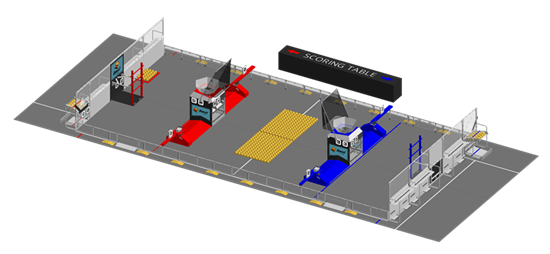
Figure 6‑1 REBUILT

image

In REBUILT, 2

ALLIANCES
(an
ALLIANCE
is a cooperative of up to 4 FIRST Robotics Competition teams) play
MATCHES
, set up and implemented per the details described below.

6.1
MATCH
Overview

MATCHES
run on 7–10-minute cycles, which consist of pre-MATCH setup, the 2-minute and 40-second
MATCH
, and the post-MATCH reset.

During the

MATCH
,
ROBOTS
collect
FUEL
and score in their
HUB
. HUMAN PLAYERS can deliver
FUEL
to
ROBOTS
or score them in their
HUB
.

ROBOTS
conclude the
MATCH
climbing on their
TOWER
.

6.2 DRIVE TEAM

A DRIVE TEAM is a set of up to 5 people from the same FIRST Robotics Competition team responsible for team performance for a specific

MATCH
. There are 4 specific roles on a DRIVE TEAM which
ALLIANCES
can use to assist
ROBOTS
, and no more than 1 member of the DRIVE TEAM may be a non-STUDENT.

The intent of the definition of DRIVE TEAM and DRIVE TEAM related rules is that, barring extenuating circumstances, the DRIVE TEAM consists of people who arrived at the event affiliated with that team and are responsible for their team’s and

ROBOT
’S performance at the event (this means a person may be affiliated with more than 1 team).

The intent is not to allow teams to “adopt” members of other teams for strategic advantage for the loaning team, borrowing team, and/or their

ALLIANCE
(e.g. an
ALLIANCE
CAPTAIN believes 1 of their
DRIVERS
has more experience than a
DRIVER
on their first pick, and the teams agree the first pick team will “adopt” that
DRIVER
and make them a member of their DRIVE TEAM for Playoffs).

The definition isn’t stricter for 2 main reasons. First, to avoid additional bureaucratic burden on teams and event volunteers (e.g. requiring that teams submit official rosters that Queuing must check before allowing a DRIVE TEAM into the

ARENA
). Second, to provide space for exceptional circumstances that give teams the opportunity to display Gracious Professionalism (e.g. a bus is delayed, a DRIVE COACH has no
DRIVERS
, and their pit neighbors agree to help by loaning
DRIVERS
as temporary members of the team until their bus arrives).

Table 6‑1 DRIVE TEAM roles
RoleDescriptionMax./ DRIVE TEAMCriteria
DRIVE COACHa guide or advisor1any team member, must wear “DRIVE COACH” button
TECHNICIAN
a resource for
ROBOT
troubleshooting, setup, and removal from the
FIELD
1any team member, must wear “
TECHNICIAN
” button
DRIVER
an operator and controller of the
ROBOT
3
STUDENT
, must wear a “DRIVE TEAM” button
HUMAN PLAYERa SCORING ELEMENT manager3
STUDENT
, must wear a “DRIVE TEAM” button

A

STUDENT
is a person who has not completed high-school, secondary school, or the comparable
level
as of September 1 prior to Kickoff.

The

TECHNICIAN
provides teams with a technical resource for pre-MATCH setup,
ROBOT
connectivity, OPERATOR CONSOLE troubleshooting, and post-MATCH removal of the
ROBOT
. Some pre-MATCH responsibilities for the
TECHNICIAN
may include, but are not limited to:

  • location of the
    ROBOT
    radio, its power connection, and understanding of its indicator lights
  • location of the roboRIO and understanding of its indicator lights
  • username and password for the OPERATOR CONSOLE
  • restarting the
    Driver
    Station and Dashboard software on the OPERATOR CONSOLE
  • changing the bandwidth utilization (e.g. camera resolution, frame rate, etc.)
  • changing a battery
  • charging pneumatics

While the

TECHNICIAN
may be the primary technical member of the DRIVE TEAM, all members of the DRIVE TEAM are encouraged to have knowledge of the basic functionality of the
ROBOT
, such as the location and operation of the main circuit breaker, connecting and resetting joysticks or gamepads from the OPERATOR CONSOLE, and removing the
ROBOT
from the
FIELD
.

Per Table 6‑1, each team is allotted up to 3

STUDENTS
who may be assigned as
DRIVERS
or HUMAN PLAYERS. If multiple teams on an
ALLIANCE
do not have 3
STUDENTS
at the event to act in these roles, 1 of the
ALLIANCE
’S teams may substitute a
STUDENT
TECHNICIAN
as a HUMAN PLAYER for that
MATCH
only. In this case,

  • the Head
    REFEREE
    must be notified,
  • all HUMAN PLAYER rules now apply to this DRIVE TEAM member, and
  • this DRIVE TEAM member is no longer considered a
    TECHNICIAN
    for that
    MATCH
    .

6.3 Setup

Before each

MATCH
begins,
FIELD
STAFF stage SCORING ELEMENTS as described in section 6.3.4 SCORING ELEMENTS. DRIVE TEAMS stage their
ROBOTS
(as described in section 6.3.3
ROBOTS
) and OPERATOR CONSOLES (as described in section 6.3.2 OPERATOR CONSOLES). Then, DRIVE TEAMS take their places as described in section 6.3.1 DRIVE TEAMS.

6.3.1 DRIVE TEAMS

DRIVE TEAMS prepare for a

MATCH
by staging in the appropriate areas, according to their role on the DRIVE TEAM, and by identifying themselves accordingly. DRIVE TEAM starting conditions are listed below, and a DRIVE TEAM obstructing or delaying any of the conditions is at risk of violating G301.

  • A. only DRIVE TEAM members assigned to the upcoming
    MATCH
    are present,
  • B. for Qualification
    MATCHES
    only DRIVE TEAM members whose
    ROBOTS
    have passed initial, complete Inspection are present,
  • C. any number of HUMAN PLAYERS are staged in their
    OUTPOST
    AREAS,
  • D. HUMAN PLAYERS not included in C,
    DRIVERS
    , and DRIVE COACHES are in their
    ALLIANCE
    AREA and behind the HUMAN STARTING LINE,
  • E.
    TECHNICIANS
    are in the event-designated area near the
    FIELD
    ,
  • F. DRIVE TEAM members clearly display their designated buttons above their waists (DRIVE COACH - “Drive Coach”,
    DRIVERS
    and HUMAN PLAYERS - “Drive Team”, and
    TECHNICIAN
    - “
    Technician
    ”), and
  • G. if a Playoff
    MATCH
    , the
    ALLIANCE
    CAPTAIN clearly displays their designated
    ALLIANCE
    CAPTAIN identifier (e.g. hat or armband).

6.3.2 OPERATOR CONSOLES

DRIVE TEAMS set up their OPERATOR CONSOLE as soon as the DRIVE TEAM from the previous

MATCH
has cleared the area. OPERATOR CONSOLES must be compliant with all relevant rules, specifically those in section 8.9 OPERATOR CONSOLE. The OPERATOR CONSOLE is plugged into the team’s assigned
DRIVER
STATION, as indicated on the team sign. Any
control
devices worn or held by their HUMAN PLAYERS and/or
DRIVERS
during the
MATCH
must be disconnected from or set on or beside the OPERATOR CONSOLE before the
MATCH
can begin. A DRIVE TEAM obstructing or delaying OPERATOR CONSOLE setup is at risk of violating G301.

For the purposes of FIRST Robotics Competition, any device connected to the OPERATOR CONSOLE is considered a

control
device because
REFEREES
are not expected to differentiate between devices that can or cannot
control
the
ROBOT
.

6.3.3
ROBOTS

DRIVE TEAMS stage their

ROBOT
in accordance with G303. A DRIVE TEAM obstructing or delaying
ROBOT
setup requirements is at risk of violating G301.

If order of placement matters to either or both

ALLIANCES
, the
ALLIANCE
notifies the Head
REFEREE
during setup for that
MATCH
, and the Head
REFEREE
instructs
ALLIANCES
to alternate placement of
ROBOTS
. In a Qualification
MATCH
,
REFEREE
instructions are that
ROBOTS
are placed in the following order:

  • red
    DRIVER
    STATION 1
    ROBOT
  • blue
    DRIVER
    STATION 1
    ROBOT
  • red
    DRIVER
    STATION 2
    ROBOT
  • blue
    DRIVER
    STATION 2
    ROBOT
  • red
    DRIVER
    STATION 3
    ROBOT
  • blue
    DRIVER
    STATION 3
    ROBOT

In an intra-Division Playoff

MATCH
, the same pattern is applied, but instead of blue
ALLIANCE
placing last, the higher seeded
ALLIANCE
(regardless of color) places last. For inter-Division Playoff
MATCHES
, the
ALLIANCE
that places last is determined by a (real or virtual) coin flip facilitated by the Head
REFEREE
where a “heads” result invites the red
ALLIANCE
to place last.

FIELD
STAFF may ask teams to indicate their intended location and are not required to wait for a team to stage their
ROBOT
in its exact location before moving to the next team.

6.3.4 SCORING ELEMENTS

Before each

MATCH
begins,
FIELD
STAFF stage SCORING ELEMENTS.

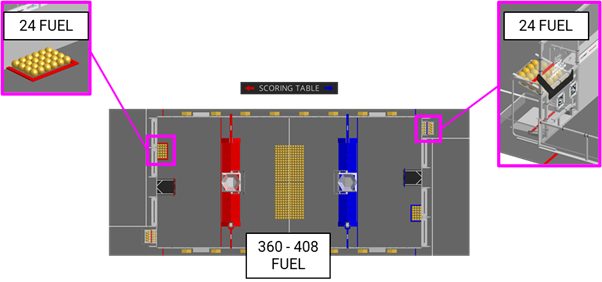
Figure 6‑2 SCORING ELEMENT staging positions

image

504

FUEL
are staged for each
MATCH
as follows (reference Figure 6‑2):

  • A. 24
    FUEL
    are staged in each
    DEPOT
    (
    FUEL
    may not be in a uniform layout),
  • B. 24
    FUEL
    are staged in each
    OUTPOST
    CHUTE
    ,
  • C. 8
    FUEL
    may be preloaded in each
    ROBOT
    by the
    ROBOT
    ’S DRIVE TEAM, such that each
    FUEL
    is fully supported by the
    ROBOT
    (up to 48 total; a
    FUEL
    not pre-loaded in a
    ROBOT
    is staged in the NEUTRAL ZONE), and
  • D. remaining
    FUEL
    are arranged in the NEUTRAL ZONE through a process listed in Section 6.3.4.1 (360 to 408, depending on how many are preloaded in
    ROBOTS
    ).

Due to the high number of SCORING ELEMENTS in REBUILT,

FIELD
STAFF may not be able to perfectly count all
FUEL
put into the NEUTRAL ZONE. The number of
FUEL
staged in the NEUTRAL ZONE for any given
match
may fluctuate around +/- 24
FUEL
.

For District Championship and/or FIRST Championship events, the quantity of

FUEL
staged in a
MATCH
may increase up to 600. If this happens, the additional
FUEL
will be included as part of an updated
FUEL
arrangement in the NEUTRAL ZONE.

6.3.4.1 NEUTRAL ZONE
FUEL
ARRANGEMENT

The NEUTRAL ZONE is staged by the
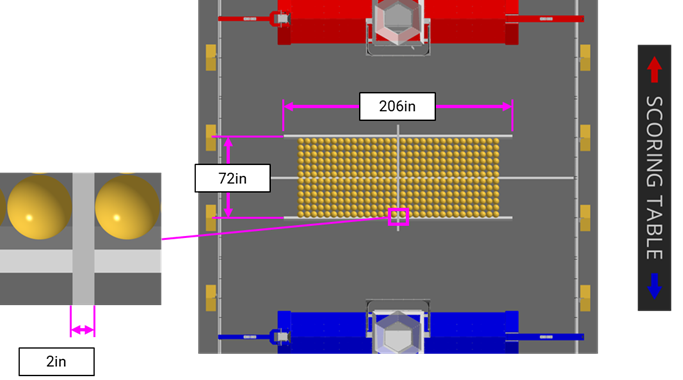
FIELD
crew by corralling all
FUEL
within a bounding box that is approximately 206.0in (5.23m) wide and 72.0in (1.83m) deep. The bounding box has a solid divider in the middle that is 2.0in (5.08cm) wide that will result in a small gap in
FUEL
. The dividers will be removed prior to the start of the
MATCH
.

Figure 6‑3 NEUTRAL ZONE
FUEL
setup

image

The expected result of the dispersal is a roughly equal split of

FUEL
on both sides of the CENTER LINE. The dispersal between the scoring table side and non-scoring table side of the
field
is expected to vary
match
to
match
.

The placement of

FUEL
in the NEUTRAL ZONE is not intended to be in a perfect grid. Teams should expect variances in the placement of
FUEL
in the NEUTRAL ZONE at the start of the
MATCH
.

6.4
MATCH
Periods

The first period of each

MATCH
is 20 seconds long and called the Autonomous Period (
AUTO
). During
AUTO
,
ROBOTS
operate without any DRIVE TEAM
control
or input.
ROBOTS
score SCORING ELEMENTS, may leave their
ROBOT
STARTING LINE and retrieve additional SCORING ELEMENTS, and may climb their
TOWER
. There is a 3-second delay between
AUTO
and
TELEOP
for scoring purposes as described in section 6.5 Scoring.

The second period of each

MATCH
is the remaining 2 minutes and 20 seconds (2:20) and called the Teleoperated Period (
TELEOP
). During
TELEOP
,
DRIVERS
remotely operate
ROBOTS
to retrieve and score SCORING ELEMENTS and climb their
TOWER
.
TELEOP
is split into further segments: the TRANSITION
SHIFT
, the
ALLIANCE
SHIFTS
, and END GAME. There are four
ALLIANCE
SHIFTS
named
SHIFT
1,
SHIFT
2,
SHIFT
3, and
SHIFT
4. The duration of each timeframe is shown in Table 6‑2.

Table 6‑2:
MATCH
SHIFTS
MATCH
Period
MATCH
Timeframe
DurationTimer Values
AUTO
AUTO
20 Seconds0:20 – 0:00
TELEOP
TRANSITION
SHIFT
10 Seconds2:20 – 2:10
TELEOP
SHIFT
1
25 Seconds2:10 – 1:45
TELEOP
SHIFT
2
25 Seconds1:45 – 1:20
TELEOP
SHIFT
3
25 Seconds1:20 – 0:55
TELEOP
SHIFT
4
25 Seconds0:55 – 0:30
TELEOP
END GAME30 Seconds0:30 – 0:00

6.4.1
HUB
Status

During the

MATCH
, the status of a
HUB
can be either active or inactive.
FUEL
scored in an active
HUB
is worth
MATCH
points but
FUEL
scored in an inactive
HUB
will not earn any points as shown in Table 6‑3. Both
ALLIANCE
HUBS
are active during
AUTO
, the TRANSITION
SHIFT
, and END GAME. During the
ALLIANCE
SHIFTS
, only one
ALLIANCE
HUB
will be active while the other
ALLIANCE
’S
HUB
becomes inactive.

The status of both

HUBS
during the
ALLIANCE
SHIFTS
is based on the results of
AUTO
. The
ALLIANCE
that scores the most
FUEL
during
AUTO
will have their
HUB
set to inactive for
SHIFT
1 while their opponent’s
HUB
will be active, as shown in Table 6‑3.
HUB
statuses will then alternate at the start of each following
ALLIANCE
SHIFT
, until the start of END GAME where both
HUBS
return to active. If both
ALLIANCES
score the same number of
FUEL
during
AUTO
, the
FMS
will randomly select an
ALLIANCE
and use its
HUB
status order for the
ALLIANCE
SHIFTS
during the
MATCH
.

FMS
relays the
ALLIANCE
who scored more
FUEL
during
AUTO
, or the
ALLIANCE
selected by
FMS
, to all OPERATOR CONSOLES simultaneously at the start of
TELEOP
. Specific details on the format of the data can be found on the 2026 FRC
Control
System website
.

Table 6‑3:
Hub
Status during
MATCH
Timeframes
AUTO
Result:
RED
ALLIANCE
scores more
FUEL
during
AUTO
or is selected by the
FMS
RED
ALLIANCE
scores more
FUEL
during
AUTO
or is selected by the
FMS
BLUE
ALLIANCE
scores more
FUEL
during
AUTO
or is selected by the
FMS
BLUE
ALLIANCE
scores more
FUEL
during
AUTO
or is selected by the
FMS
MATCH
Timeframe (timer values)
RED
ALLIANCE
HUB
status
BLUE
ALLIANCE
HUB
status
RED
ALLIANCE
HUB
status
BLUE
ALLIANCE
HUB
status
AUTO
(0:20 – 0:00)
ActiveActiveActiveActive
TRANSITION
SHIFT
(2:20 – 2:10)
ActiveActiveActiveActive
SHIFT
1 (2:10 – 1:45)
InactiveActiveActiveInactive
SHIFT
2 (1:45 – 1:20)
ActiveInactiveInactiveActive
SHIFT
3 (1:20 – 0:55)
InactiveActiveActiveInactive
SHIFT
4 (0:55 – 0:30)
ActiveInactiveInactiveActive
END GAME (0:30 – 0:00)ActiveActiveActiveActive

6.5 Scoring

ALLIANCES
are rewarded for accomplishing various actions throughout a
MATCH
, including scoring
FUEL
, climbing their
TOWER
, and winning or tying
MATCHES
.

Rewards are granted either via

MATCH
points or Ranking Points (often abbreviated to
RP
, which increase the measure used to rank teams in the Qualification Tournament).

All scores are assessed and updated throughout the

MATCH
, except as follows:

  • A. assessment of
    FUEL
    scored in the
    HUB
    continues for up to 3 seconds after the
    ARENA
    timer displays 0:00 following
    AUTO
    .
  • B. assessment of
    FUEL
    scored in the
    HUB
    continues for up to 3 seconds after the
    ARENA
    timer displays 0:00 following
    TELEOP
    .
  • C. assessment of
    AUTO
    TOWER
    points is made after the
    ARENA
    timer displays 0:00 following
    AUTO
    .
  • D. assessment of
    TELEOP
    TOWER
    points is made 3 seconds after the
    ARENA
    timer displays 0:00 following
    TELEOP
    , or when all
    ROBOTS
    have come to rest following the conclusion of the
    MATCH
    , whichever happens first.

Assessment of

FUEL
scored in the
HUB
continues for 3 seconds after the
HUB
deactivates to account for
FUEL
processing time.

TOWER
points are evaluated and scored by human volunteers. Teams are encouraged to make sure that it is obvious and unambiguous that the criteria are met.

6.5.1 SCORING ELEMENT Scoring Criteria

A

FUEL
is scored in the
HUB
once it passes through the top opening of the
HUB
and through the sensor array.

6.5.2
ROBOT
Scoring Criteria

To qualify for

TOWER
points for a given
LEVEL
, a
ROBOT
must meet the following conditions:

  • For
    LEVEL
    1 – a
    ROBOT
    must no longer touching the CARPET or the
    TOWER
    BASE, or
  • For
    LEVEL
    2 – a
    ROBOT
    must be positioned such that its
    BUMPERS
    are completely above the LOW
    RUNG
    , or
  • For
    LEVEL
    3 – a
    ROBOT
    must be positioned such that its
    BUMPERS
    are completely above the MID
    RUNG
    .

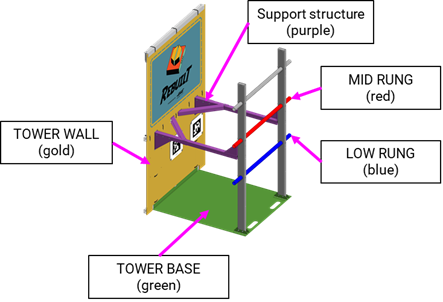
Additionally, a

ROBOT
must be contacting the
RUNGS
or
UPRIGHTS
and may additionally only contact the following elements:

  • A. the
    TOWER
    WALL,
  • B. support structure,
  • C.
    FUEL
    , and/or.
  • D. another
    ROBOT
    .

A

ROBOT
may only earn
TOWER
points for
LEVEL
1 during
AUTO
. A
ROBOT
may only earn
TOWER
points for a single
LEVEL
during
TELEOP
.

Figure 6‑4:
TOWER
contact limitation for
ROBOT
Scoring Criteria

image

6.5.3 Point Values

Point values for tasks in REBUILT are detailed in Table 6‑4.

Table 6‑4 REBUILT point values
MATCH
points
MATCH
points
Ranking Points
AUTO
TELEOP
Ranking Points
FUEL
FUEL
scored in an active
HUB
11
FUEL
FUEL
scored in an inactive
HUB
--
TOWER
Each
ROBOT
at
LEVEL
1 (2
ROBOTS
max in
AUTO
)
1510
TOWER
Each
ROBOT
at
LEVEL
2
-20
TOWER
Each
ROBOT
at
LEVEL
3
-30
*ENERGIZED
RP
– The amount of
FUEL
scored in the
HUB
is at or above threshold.
*ENERGIZED
RP
– The amount of
FUEL
scored in the
HUB
is at or above threshold.
*ENERGIZED
RP
– The amount of
FUEL
scored in the
HUB
is at or above threshold.
*ENERGIZED
RP
– The amount of
FUEL
scored in the
HUB
is at or above threshold.
1
*SUPERCHARGED
RP
– The amount of
FUEL
scored in the
HUB
is at or above threshold.
*SUPERCHARGED
RP
– The amount of
FUEL
scored in the
HUB
is at or above threshold.
*SUPERCHARGED
RP
– The amount of
FUEL
scored in the
HUB
is at or above threshold.
*SUPERCHARGED
RP
– The amount of
FUEL
scored in the
HUB
is at or above threshold.
1
*TRAVERSAL
RP
– The amount of
TOWER
points scored during the
MATCH
is at or above threshold.
*TRAVERSAL
RP
– The amount of
TOWER
points scored during the
MATCH
is at or above threshold.
*TRAVERSAL
RP
– The amount of
TOWER
points scored during the
MATCH
is at or above threshold.
*TRAVERSAL
RP
– The amount of
TOWER
points scored during the
MATCH
is at or above threshold.
1
Wincompleting a
MATCH
with more
MATCH
points than your opponent
completing a
MATCH
with more
MATCH
points than your opponent
completing a
MATCH
with more
MATCH
points than your opponent
3
Tiecompleting a
MATCH
with the same number of
MATCH
points as your opponent
completing a
MATCH
with the same number of
MATCH
points as your opponent
completing a
MATCH
with the same number of
MATCH
points as your opponent
1
*See Table 6‑5 for threshold values. For District Championship and/or FIRST Championship events, the BONUS
RP
(ENERGIZED
RP
, SUPERCHARGED
RP
, and TRAVERSAL
RP
) requirement thresholds may increase.
*See Table 6‑5 for threshold values. For District Championship and/or FIRST Championship events, the BONUS
RP
(ENERGIZED
RP
, SUPERCHARGED
RP
, and TRAVERSAL
RP
) requirement thresholds may increase.
*See Table 6‑5 for threshold values. For District Championship and/or FIRST Championship events, the BONUS
RP
(ENERGIZED
RP
, SUPERCHARGED
RP
, and TRAVERSAL
RP
) requirement thresholds may increase.
*See Table 6‑5 for threshold values. For District Championship and/or FIRST Championship events, the BONUS
RP
(ENERGIZED
RP
, SUPERCHARGED
RP
, and TRAVERSAL
RP
) requirement thresholds may increase.
*See Table 6‑5 for threshold values. For District Championship and/or FIRST Championship events, the BONUS
RP
(ENERGIZED
RP
, SUPERCHARGED
RP
, and TRAVERSAL
RP
) requirement thresholds may increase.
Table 6‑5: REBUILT BONUS
RP
thresholds
BONUS
RP
Type
Regional/ District EventsDistrict ChampionshipsFIRST Championship
ENERGIZED
RP
100TBATBA
SUPERCHARGED
RP
360TBATBA
TRAVERSAL
RP
50TBATBA

BONUS

RP
thresholds for District Championships and FIRST Championship will be announced in Team Updates.

6.6 Violations

Unless otherwise noted, all violations are assigned for each instance of a rule violation. A description of the penalties is listed in Table 6‑6. All rules throughout the Game Rules section are called as perceived by a

REFEREE
.

Table 6‑6 Rule violations
PenaltyDescription
MINOR FOULa credit of 5 points towards the opponent’s
MATCH
point total
MAJOR FOULa credit of 15 points towards the opponent’s
MATCH
point total
YELLOW CARDissued by the Head
REFEREE
for egregious
ROBOT
or team member behavior or rule violations. A subsequent YELLOW CARD within the same tournament phase results in a RED CARD.
RED CARDissued by the Head
REFEREE
for egregious
ROBOT
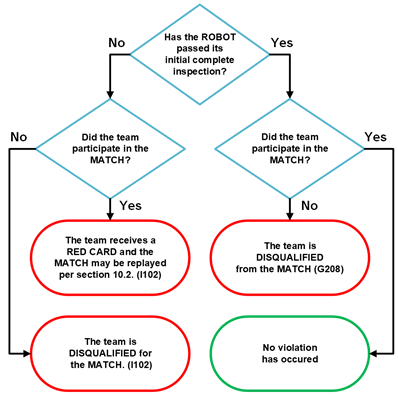
or team member behavior or rule violations which results in a team being
DISQUALIFIED
for the
MATCH
.
DISABLED
the state in which a
ROBOT
is commanded to deactivate all outputs, rendering the
ROBOT
inoperable for the remainder of the
MATCH
.
DISQUALIFIED
the state of a team in which they receive 0
MATCH
points and 0 Ranking Points in a Qualification
MATCH
or causes their
ALLIANCE
to receive 0
MATCH
points in a Playoff
MATCH
VERBAL WARNINGa warning issued by event staff or the Head
REFEREE
.
ALLIANCE
is ineligible for
RP
An
ALLIANCE
is ineligible for the specified
RP
for that
MATCH
. This overrides any
RP
awarded through normal
MATCH
play or other rule violations.

6.6.1 YELLOW and RED CARDS

In addition to rule violations explicitly listed throughout this document, YELLOW CARDS and RED CARDS are used in FIRST Robotics Competition to address team and

ROBOT
behavior that does not align with the mission, values, and culture of FIRST.

The Head

REFEREE
may assign a YELLOW CARD as a warning, or a RED CARD for egregious behavior inappropriate at a FIRST Robotics Competition event.

If an action resulting in the assignment of a YELLOW or RED CARD is determined to be the result of an

ARENA
FAULT, per section 10.2, the CARD will be rescinded.

A YELLOW or RED CARD is indicated on the audience display

MATCH
results screen. During Qualification
MATCHES
, A YELLOW or RED CARD is indicated next to the team who received the CARD and the Game Announcer describes the violation. During Playoff
MATCHES
, the card is applied to the whole
ALLIANCE
and as such “RED CARD" or "YELLOW CARD" appears above the
ALLIANCE
number.

YELLOW CARDS are additive, meaning that a second YELLOW CARD is automatically converted to a RED CARD. A team is issued a RED CARD for any subsequent incident in which they receive an additional YELLOW CARD, including earning a second YELLOW CARD during a single

MATCH
. A second YELLOW CARD is indicated by the Head
REFEREE
holding a YELLOW CARD and RED CARD in the air simultaneously after the completion of the
MATCH
. A team that has received either a YELLOW CARD or a RED CARD carries a YELLOW CARD into subsequent
MATCHES
, except as noted below.

Once a team receives a YELLOW or RED CARD, a yellow rectangle will show next to the team number on the audience display during subsequent

MATCHES
, including any replays.

Figure 6‑5 Example audience screen graphic showing YELLOW CARD indicators

image

All YELLOW CARDS are cleared in

FMS
at the conclusion of Practice, Qualification, and division Playoff
MATCHES
. VERBAL WARNINGS issued by the head
REFEREE
are cleared after Practice
MATCHES
and persist from Qualification
MATCHES
through subsequent tournament phases.

6.6.2 YELLOW and RED CARD application

YELLOW and RED CARDS are applied based on the following:

Table 6‑7: YELLOW and RED CARD application
Time YELLOW or RED CARDS earned:
MATCH
to which CARD is applied:
Prior to Qualification
MATCHES
REFEREES
may or may not be present during Practice
MATCHES
. With input from event staff, the Head
REFEREE
may opt to perpetuate a VERBAL WARNING or YELLOW CARD earned prior to Qualification
MATCHES
to the first Qualification
MATCH
for particularly egregious behavior.
during the Qualification
MATCHES
team’s current (or just-completed)
MATCH
. In the case where the team participated as a
SURROGATE
in the current (or just completed)
MATCH
, the card is applied to the team’s previous
MATCH
(i.e. the team’s second Qualification
MATCH
)
between the end of Qualification
MATCHES
and the start of Playoff
MATCHES
ALLIANCE
’S first Playoff
MATCH
during the Playoff
MATCHES
ALLIANCE
’S current (or just-completed)
MATCH

A

MATCH
is no longer the current
MATCH
once the results of the
MATCH
have been posted or the Head
REFEREE
or their designee has indicated that teams can collect their
ROBOTS
, whichever is later.

Please see examples of the application of YELLOW and RED CARDS as shown in section 6.6.4 Violation Details.

6.6.3 YELLOW and RED CARDS during Playoff
MATCHES

During Playoff

MATCHES
, YELLOW and RED CARDS are assigned to the violating team’s entire
ALLIANCE
instead of to only the violating team. If an
ALLIANCE
receives 2 YELLOW CARDS, the entire
ALLIANCE
is issued a RED CARD which results in DISQUALIFICATION for the associated
MATCH
. If both
ALLIANCES
receive a RED CARD, the
ALLIANCE
assessed the first RED CARD, chronologically, is
DISQUALIFIED
and loses the
MATCH
.

6.6.4 Violation Details

There are several styles of violation wording used in this manual. Below are some example violations and a clarification of the way the violation would be assessed. The examples shown do not represent all possible violations, but rather a representative set of combinations.

Table 6‑8 Violation examples
Example ViolationExpanded Interpretation
MINOR FOULUpon violation, a MINOR FOUL is assessed against the violating
ALLIANCE
.
MAJOR FOUL and YELLOW CARDUpon violation, a MAJOR FOUL is assessed against the violating
ALLIANCE
. After the
MATCH
, the Head
REFEREE
presents the violating team with a YELLOW CARD.
MINOR FOUL per additional SCORING ELEMENT. If egregious, YELLOW CARDUpon violation, a number of MINOR FOULS are assessed against the violating
ALLIANCE
equal to the number of additional SCORING ELEMENTS beyond the permitted quantity. Additionally, if the
REFEREES
determine that the action was egregious, the Head
REFEREE
presents the violating team with a YELLOW CARD after the
MATCH
.
MINOR FOUL. MAJOR FOUL IF
REPEATED
Upon initial violation in a
MATCH
, a MINOR FOUL is assessed against the violating
ALLIANCE
. If the
ALLIANCE
ROBOT
repeats the infraction in the
MATCH
, a MAJOR FOUL is assessed against the violating
ALLIANCE
. Assuming no additional infractions of that rule by that
ROBOT
in that
MATCH
, the
ROBOT
has “earned” a MINOR FOUL and a MAJOR FOUL for their
ALLIANCE
.
MAJOR FOUL, and for every 3 seconds in which the situation is not corrected, a MAJOR FOUL is assessedUpon violation, a MAJOR FOUL is assessed against the violating
ALLIANCE
and the
REFEREE
begins to count. Their count continues until the criteria to discontinue the count are met, and for each 3 seconds within that time, an additional MAJOR FOUL is assessed against the violating
ALLIANCE
. A
ROBOT
in violation of this type of rule for 15 seconds receives a total of 6 MAJOR FOULS (assuming no other rules were being simultaneously violated).
RED CARD for the
ALLIANCE
After the
MATCH
, the Head
REFEREE
presents the violating
ALLIANCE
with a RED CARD in the following fashion: · In a PLAYOFF
MATCH
, a single RED CARD is assessed to the
ALLIANCE
. · In all other scenarios, each team on the
ALLIANCE
is issued a RED CARD.

6.7 Head
REFEREE
and
FTA
Interaction

The Head

REFEREE
has the ultimate authority in the
ARENA
during the event, but may receive input from additional sources, e.g. Game Designers, FIRST personnel,
FTA
, and other event staff. The Head
REFEREE
rulings are final. No event staff, including the Head
REFEREE
, will review video, photos, artistic renderings, etc. of any
MATCH
, from any source, under any circumstances.

6.7.1 Question Box (Q)

Each

ALLIANCE
has a designated Question Box near the scoring table. If a DRIVE TEAM has a question about a
MATCH
, the
FIELD
, etc., they may send up to 2 DRIVE TEAM members to their corresponding Question Box. Depending on timing, the Head
REFEREE
or
FTA
may postpone any requested discussion until the end of the subsequent
MATCH
.

Technical questions regarding

FIELD
or
ROBOT
operation are addressed by the
FTA
, and additional team members are invited to participate in these conversations if necessary. If a DRIVE TEAM needs clarification on a ruling or score, per Q101, up to 2 DRIVE TEAM members should address the Head
REFEREE
after the
ARENA
Reset Signal (e.g.
FIELD
lights turn green).

While

FMS
tracks quantities of MINOR and MAJOR FOULS, FIRST instructs
REFEREES
to not self-track details about MINOR FOULS and MAJOR FOULS; as a result,
REFEREES
are not expected to recall details about what MINOR FOULS and MAJOR FOULS were made, when they occurred, and against whom.

Any reasonable question is fair game in the Question Box, and Head

REFEREES
will make good faith efforts to provide helpful feedback (e.g. how/why certain MINOR FOULS are being called, why a particular
ROBOT
may be susceptible to certain MINOR FOULS based on its design or game play, how specific rules are being called or interpreted), but please know that they may not be able to supply specific details.

Q101 *Head

REFEREE
Interactions. A team may only address the Head
REFEREE
with maximum of 2 people, 1 of which must be a
STUDENT
.

Violation: The Head
REFEREE
will not address non-compliant team members or peripheral conversations.

Some events may restrict

ARENA
access to members of the DRIVE TEAM. Team members are permitted to swap buttons within their team as needed to access the Question Box.

As much as possible, the

STUDENT
should be an active participant in the conversation.

Teams should not record interactions without consent (see E117).

Q102 Conversations must be civil. Any team interaction with the Head

REFEREE
must be appropriate.

Violation: The Head
REFEREE
may terminate the conversation to allow time for parties to cool down. A person with subsequent violations will not be allowed to interact with the Head
REFEREE
.

Examples of inappropriate behavior are outlined in G201.

6.8 Other Logistics

SCORING ELEMENTS that leave the

FIELD
(other than through the
OUTPOST
) are placed back into the
FIELD
approximately at the point of exit by
FIELD
STAFF (
REFEREES
,
FTAs
, or other staff working around the
FIELD
) at the earliest safe opportunity.

Note that

ROBOTS
and HUMAN PLAYERS may not deliberately cause SCORING ELEMENTS to leave the
FIELD
(see G405).

An

ARENA
FAULT (an error in
ARENA
operation described in section 10.2
MATCH
Replays) is not called for
MATCHES
that accidentally begin with damaged SCORING ELEMENTS. Damaged SCORING ELEMENTS are not replaced until the next
ARENA
reset period. DRIVE TEAMS should alert the
FIELD
STAFF to any missing or damaged SCORING ELEMENTS prior to the start of the
MATCH
but as noted in 6.3.4, the exact number of
FUEL
in the NEUTRAL ZONE may vary.

Once the

MATCH
is over and the Head
REFEREE
determines that the
FIELD
is safe for
FIELD
STAFF and DRIVE TEAMS, they or their designee change the
FIELD
lights to green and DRIVE TEAMS may retrieve their
ROBOT
. Some
MATCHES
may include a short period afterward to allow
FIELD
staff to begin to clean the
field
to make it easier and safer for teams to collect their
robot
. This period is indicated with purple lights on the team signs and the word “clean” displayed. TEAMS are not allowed on the
field
during this time.

During

ARENA
reset, the
ARENA
is cleared of
ROBOTS
and OPERATOR CONSOLES from the
MATCH
that just ended,
ROBOTS
and OPERATOR CONSOLES for the subsequent
MATCH
are loaded into the
ARENA
by DRIVE TEAMS, and
FIELD
STAFF reset
ARENA
elements.

FIRST Robotics Competition uses 3 words in the context of how durations and actions are assessed with regards to evaluation of rules and assignment of violations. These words provide general guidance to describe benchmarks to be used across the program. It is not the intent for

REFEREES
to provide a count during the time periods.

  • MOMENTARY
    describes durations that are fewer than approximately 3 seconds.
  • CONTINUOUS
    describes durations that are more than approximately 10 seconds.
  • REPEATED
    describes actions that happen more than once within a
    MATCH
    .

image