2026

5 ARENA

The

ARENA
includes all elements of the game infrastructure that are required to play REBUILTTM presented by Haas: the
FIELD
, SCORING ELEMENTS, queue area, team media area (when available), designated
TECHNICIAN
area, and all equipment needed for
FIELD
control
,
ROBOT
control
, and scorekeeping.

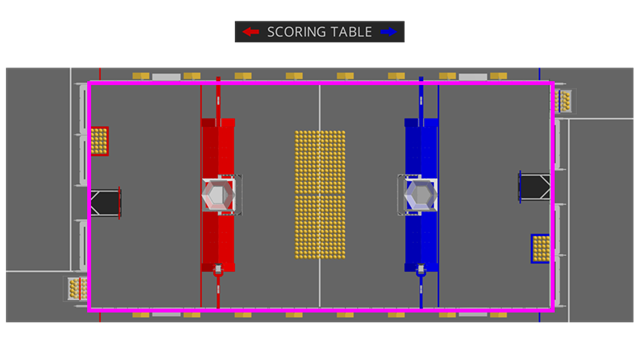
Figure 5‑1 REBUILT
ARENA
(queue area,
TECHNICIAN
area, and media area not pictured)

image

5.1 Dimensions and Accuracy

All official models for the REBUILT

FIELD
were created in Onshape.

image

The specification for the REBUILT

FIELD
can be retrieved from a few locations:

  • The 3D CAD model is the official representation of the REBUILT
    FIELD
    and how it is constructed.
  • Illustrations included in this section are for a general visual understanding of the REBUILT
    ARENA
    , and dimensions included in the manual are nominal and no tolerances are implied. Please refer to the official drawings for exact dimensions, tolerances, and construction details.
  • The
    Field
    Dimension Drawings
    package has critical dimensions for each
    FIELD
    element.
  • The
    FIELD
    Manual (coming soon) includes instructions on how to build the
    FIELD
    along with showing the ways construction type will influence the
    field
    tolerances. It also includes many of the key dimensions which are listed in the Official
    FIELD
    Drawings.
  • The
    FIELD
    Acceptance Checklist (coming soon) includes the controlled dimensions (with relevant tolerances) which will be checked by event staff a few times throughout the event. The
    FIELD
    is expected to change during
    MATCH
    play. Teams can ask the
    FTA
    to re-check specific measurements if they believe something is out of spec prior to a
    MATCH
    beginning.

The official drawings, CAD models, and drawings for low-cost versions of important elements of the REBUILT

FIELD
are posted on the Playing
FIELD
webpage
.

The

ARENA
is modular and assembled, used, disassembled, and shipped many times during the competition season. It undergoes wear and tear. The
ARENA
is designed to withstand rigorous play and frequent shipping. Every effort is made to ensure that
ARENAS
are consistent from event to event.

However,

ARENAS
are assembled in different venues by different event staff and some small variations occur. Successful teams will design
ROBOTS
that are insensitive to these variations.

5.2
FIELD

Each

FIELD
for REBUILT is an approximately 317.7in (~8.07m) by 651.2in (~16.54m) carpeted area bounded by inward facing surfaces of the
ALLIANCE
WALLS,
OUTPOSTS
,
TOWER
WALLS, and guardrails.

Figure 5‑2
FIELD
boundary in pink

image

The

FIELD
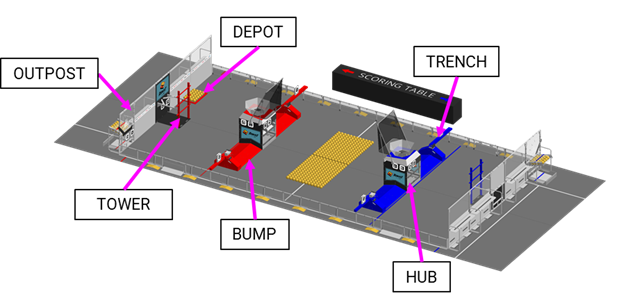
is populated with and surrounded by the following elements:

  • 1
    OUTPOST
    per
    ALLIANCE
    ,
  • 1
    HUB
    per
    ALLIANCE
    ,
  • 1
    TOWER
    per
    ALLIANCE
    ,
  • 2
    DEPOTS
    ,
  • 4
    BUMPS
    , and
  • 4
    TRENCHES
    .

The surface of the

FIELD
is low pile carpet, Shaw Floors, Philadelphia Commercial, Neyland II 20, “66561 Medallion.” Neyland II carpet is not available for purchase at this time, and the closest equivalent is Shaw, Philadelphia Brand, Profusion 20, Style 54933; see results from evaluation in this blog post.

Carpet edges and seams are secured with 3MTM Premium Matte Cloth (Gaffers) Tape GT2, GT3 or comparable Gaffer’s Tape. Tears, rips, and damage to the carpet may be repaired with the same styles of tape and

ROBOTS
must be prepared to operate on surfaces made of carpet, tape, or combinations of both materials as repairs are made through the course of competition.

Guardrails form the long edges of the

FIELD
. Guardrails are a 20.0in (50.8cm) tall system of transparent polycarbonate supported on the top and bottom by aluminum extrusion. There are 4 gates in the guardrail that allow access to the
FIELD
for placement and removal of
ROBOTS
. The gate passthrough, when open, is 38.0in (96.5cm) wide. Gates are closed and shielded during the
MATCH
.

Figure 5‑3 Gate locations

image

There are 2 versions of guardrails and

DRIVER
STATIONS used for competitions. 1 design is the Welded
FIELD
which is reflected in the 2026 Official FIRST
FIELD
Drawings & Models
. The other is designed and sold by AndyMark. Table 5‑1 and

Table 5‑2 illustrate which areas have each kind of

FIELD
. While the designs are slightly different, the critical dimensions, performance, and expected user experience between them are the same unless otherwise noted. Detailed drawings for the AndyMark design are posted on the AndyMark website. All illustrations in this manual show the traditional Welded
FIELD
design.

Table 5‑1: District
Field
Types
District
Field
Type
FIRST ChesapeakeAndyMark
FIRST CaliforniaWelded
FIRST in MichiganWelded
FIRST in TexasAndyMark
FIRST Indiana RoboticsAndyMark
FIRST IsraelWelded
FIRST Mid-AtlanticWelded
FIRST North CarolinaAndyMark
FIRST South CarolinaWelded
FIRST WisconsinAndyMark
NE FIRSTAndyMark
OntarioWelded
Pacific NorthwestWelded
PeachtreeWelded
Table 5‑2 Regional
Field
Types
Regional Location
Field
Type
AustraliaWelded
BrazilAndyMark
CanadaWelded
ChinaAndyMark
MexicoAndyMark
TürkiyeAndyMark
United StatesWelded

5.3 Areas, Zones, & Markings

FIELD
areas, zones, and markings of consequence are described below. Unless otherwise specified, the tape used to mark lines and zones throughout the
FIELD
is 2.0in (5.1cm) 3M™ Premium Matte Cloth (Gaffers) Tape (GT2), ProGaff® Premium Professional Grade Gaffer Tape, or comparable gaffers tape.

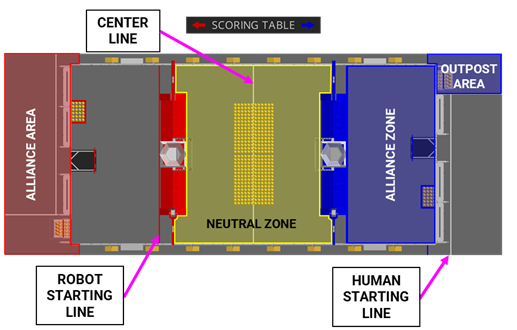
Figure 5‑4 Areas, markings, and zones

image

  • ALLIANCE
    AREA: an approximately 360in wide by 134in deep (~9.14m by 3.4m) infinitely tall volume formed by, and including the
    ALLIANCE
    WALL,
    OUTPOST
    ,
    TOWER
    WALL, the edge of the carpet, and
    ALLIANCE
    colored tape perpendicular to the
    DRIVER
    STATIONS.
  • ALLIANCE
    ZONE: A 158.6in deep by 317.7in long (~4.03m by 8.07m), infinitely tall volume formed by an
    ALLIANCE
    WALL,
    TOWER
    WALL, and guardrails. It surrounds an
    ALLIANCE
    TOWER
    and a
    DEPOT
    . It is bounded by and includes the
    ROBOT
    STARTING LINE.
  • CENTER LINE: a white line that spans the width of the
    FIELD
    that bisects the NEUTRAL ZONE in half.
  • NEUTRAL ZONE: A 283in deep by 317.7in long (7.19m by 8.07m), infinitely tall volume formed by the
    BUMPS
    ,
    TRENCHES
    ,
    HUBS
    , and guardrails. It surrounds and includes the CENTER LINE.
  • HUMAN STARTING LINE: a white line spanning the
    ALLIANCE
    AREA up to the
    OUTPOST
    AREA that is parallel to and located 24.0in (61.0cm) from the bottom square tube of the
    ALLIANCE
    WALL to the near edge of the tape.
  • OUTPOST
    AREA: a 71.0in wide by 134in deep (1.8m by 3.4m) infinitely tall volume bounded by the
    OUTPOST
    , edge of carpet, and
    ALLIANCE
    and white colored tape.
  • ROBOT
    STARTING LINE: an
    ALLIANCE
    colored line that spans the width of the
    FIELD
    at the edge of an
    ALLIANCE
    ’S BASE in front of two BARRIERS and an
    ALLIANCE
    HUB
    .

5.4
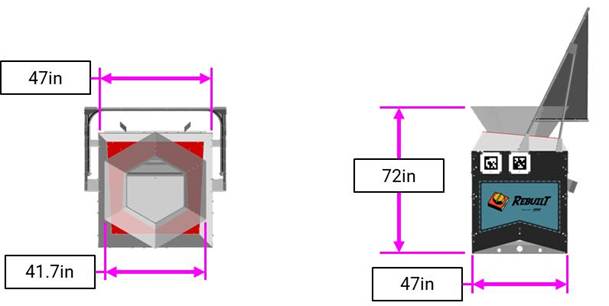
HUB

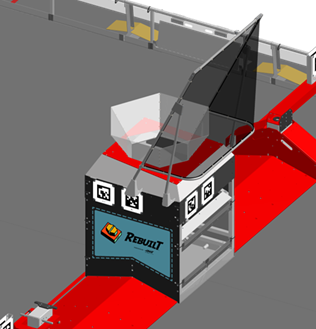
Figure 5‑5
HUB

image

A

HUB
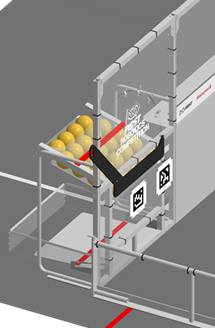
is one of two 47in by 47in (~1.19m by 1.19m) rectangular prism structures with an extended opening at the top surface. Each
ALLIANCE
has a dedicated
HUB
centered between two
BUMPS
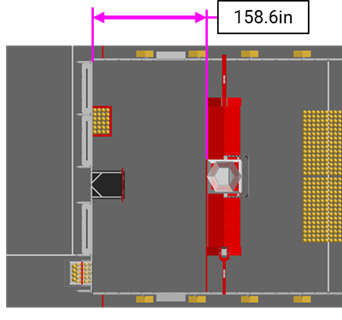
located 158.6in (~4.03m) away from their
ALLIANCE
WALL. Each
HUB
has a set of exits that randomly distributes
FUEL
into the NEUTRAL ZONE. A net structure located in the back of the
HUB
prevents
FUEL
launched from most prohibited areas from entering the opening.

Figure 5‑6:
HUB
distance to the
ALLIANCE
WALL

image

The top of each

HUB
has a 41.7in (~1.06m) hexagonal opening into which
ROBOTS
can deliver
FUEL
. The front edge of the opening is 72in (~1.83m) off the carpet.

Figure 5‑7:
HUB
Dimensions

image

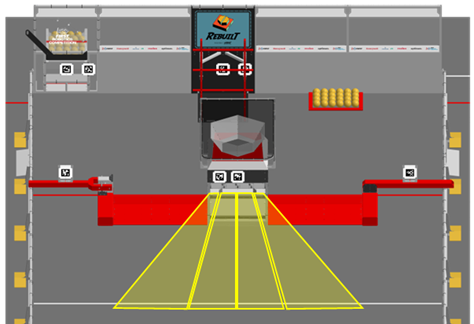
HUBS
have a series of exits at the base of the
HUB
facing towards the NEUTRAL ZONE.
FUEL
processed through the
HUB
are distributed into the NEUTRAL ZONE via one of four exits as shown in Figure 5‑8. Examples of
FUEL
distribution from the
HUB
can be found on the Playing
FIELD
webpage
.

Figure 5‑8:
HUB
exits (approximation)

image

The top angles of the

HUB
are lit by DMX light bars that indicate if the
HUB
is active. See Table 5‑3 for more details about the various light states in the
HUB
.

Table 5‑3:
HUB
Lighting
ColorPre-MATCH
MATCH
Post-Match
ALLIANCE
color at 100% brightness
N/A
HUB
active
N/A
ALLIANCE
color pulsing
N/A
HUB
deactivation warning. Starts 3 seconds before and continues until deactivation.
N/A
PurpleN/AN/A
FIELD
is safe for
FIELD
STAFF.
GreenN/AN/A
FIELD
is safe for all.
Off
MATCH
ready to start.
HUB
is not active.
N/A

5.5
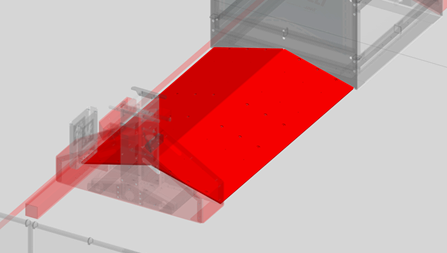
BUMP

Figure 5‑9
BUMP

image

BUMPS
are 73.0in (1.854m) wide, 44.4in (1.128m) deep, and 6.513in (16.54cm) tall structures on either side of the
HUB
that
ROBOTS
drive over. The top surface of each
BUMP
is made up of 0.5in (1.27cm) thick,
ALLIANCE
colored, Orange Peel textured, HDPE ramps at a 15-degree angle with one ramp sloping down towards the NEUTRAL ZONE and the other ramp sloping down towards the
ALLIANCE
ZONE.

5.6
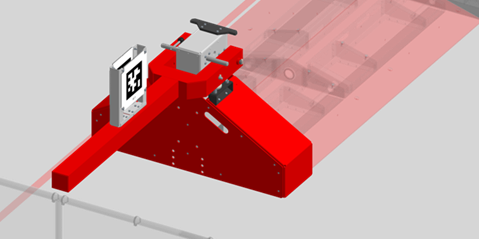
TRENCH

Figure 5‑10:
TRENCH

image

TRENCHES
are a 65.65in (1.668m) wide, 47.0in (1.194m) deep, and 40.25in (1.022m) tall structure that
ROBOTS
drive underneath. The
TRENCH
extends from the guardrail to the
BUMP
on both sides of the
FIELD
. The space underneath each
TRENCH
arm is 50.34in (1.279m) wide, 22.25in (56.52cm) tall.

TRENCHES
along the guardrail closest to the scoring table contain additional electronics to reach the
HUB
. The
TRENCHES
along the guardrail furthest from the scoring table have a pivot arm that allows the horizontal portion of the
TRENCH
to rotate into a vertical position for post-MATCH
ROBOT
retrieval and to let
FIELD
staff reset the
field
between
matches
. The pivot arm will be locked in the horizontal position during the
MATCH
.

5.7
DEPOT

Figure 5‑11:
DEPOT

image

A

DEPOT
is a 42.0in (1.07m) wide, 27.0in (68.6cm) deep structure located along the
ALLIANCE
WALL. There is 1
DEPOT
per
ALLIANCE
.
DEPOTS
are made up of 3.0in (7.62cm) wide, 1.0in (2.54) tall steel barriers. The
DEPOT
is secured to the carpet using hook fastener which increases the height to approximately 1.125in (2.86cm).

5.8
TOWER

Figure 5‑12:
TOWER

image

A

TOWER
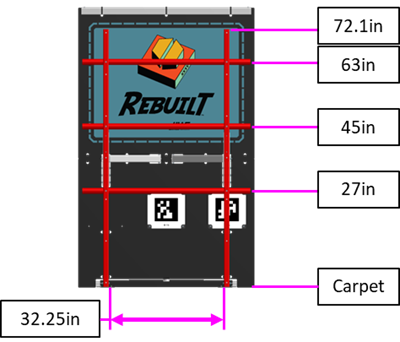
is a 49.25in (1.251m) wide, 45.0in (1.143m) deep, and 78.25in (1.988m) tall structure made up of the
TOWER
WALL,
TOWER
BASE,
UPRIGHTS
,
RUNGS
and supporting structures. There is 1
TOWER
per
ALLIANCE
. A
TOWER
is integrated into each
ALLIANCE
WALL between
DRIVER
STATION 2 and
DRIVER
STATION 3.

The

TOWER
BASE is a 39.0in (99.06cm) wide by 45.18in (1.148m) deep plate that sits on the floor and extends from the
TOWER
WALL. The
TOWER
BASE is powder-coated steel with hook fastener underneath. The edges of the
TOWER
BASE are approximately 0.2in (0.5cm) to 0.3in (0.8cm) tall.

The

UPRIGHTS
are two 72.1in (1.831m) tall, 1.5in (3.81cm) thick, 3.5in (8.89cm) deep sheet metal box frames that extend vertically up from the
TOWER
BASE. The distance between each
UPRIGHT
is 32.25in (81.92cm).

The

UPRIGHTS
hold three horizontal
RUNGS
made up of 1-1/4in Sch 40 (1.66in (4.216cm) OD) pipe. Each
RUNG
is centered between the
UPRIGHT
and extend 5.875in (14.92cm) from the outer face of the
UPRIGHT
on either side. The center of the LOW
RUNG
is located 27.0in (68.58cm) from the floor. The center of the MID
RUNG
is located 45.0in (114.3cm) from the floor. The center of the HIGH
RUNG
is 63.0in (1.6m) from the floor. The
RUNGS
are 18.0in (45.72cm) apart center to center.

The

UPRIGHTS
and
RUNGS
are powder-coated red or blue.

Each

TOWER
has additional supporting structures extending from the
UPRIGHT
to the
TOWER
WALL between approximately 28.40in (72.14cm) and 43.38in (1.102m) off the floor.

Figure 5‑13:
TOWER
Dimensions

image

5.9
ALLIANCE
WALL

The

ALLIANCE
WALL separates
ROBOTS
from DRIVE TEAM members in the
ALLIANCE
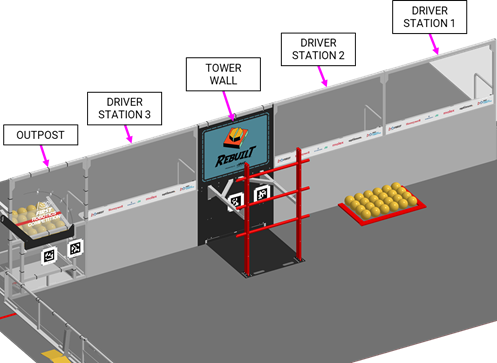
AREA. It consists of 3
DRIVER
STATIONS, an
OUTPOST
, and a
TOWER
WALL.

Figure 5‑14:
ALLIANCE
WALL

image

5.9.1
DRIVER
STATIONS

Figure 5‑15:
DRIVER
STATION (
ALLIANCE
AREA perspective and
FIELD
perspective)

image

A

DRIVER
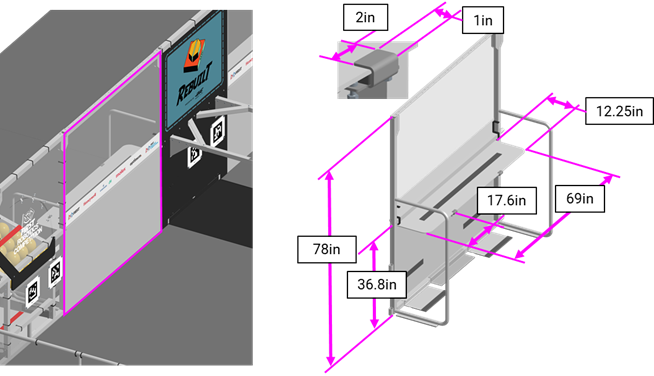
STATION is 1 of 3 assemblies within an
ALLIANCE
WALL behind which a DRIVE TEAM operates their
ROBOT
. Each
DRIVER
STATION is made from a 36.8in (93.5cm) tall diamond plate base topped with a 42in (1.07m) tall transparent plastic sheet and a top rail.

An aluminum shelf is attached to each

DRIVER
STATION to support an OPERATOR CONSOLE. The shelf is 69in (1.75m) wide and 12.25in (31.1cm) deep. There is a 54.0in (1.372m) long by 2.0in (nominal) wide strip of hook-and-loop tape (“loop” side) along the center of the support shelf that may be used to secure the OPERATOR CONSOLE to the shelf. The shelf also includes two clips to hold the shelf in place with a 1.0in (2.5cm) wide by 2.0in (5.1cm) deep tab that sits on the top surface of the shelf.

There is a 6.0in (15.2cm) tall sponsor panel in each

DRIVER
STATION. The top of this panel is 42.9in (1.09m) from the carpet.

There may be a ramp available at events for DRIVE TEAMS with limited mobility. It is designed to allow an individual using a wheelchair to access the

DRIVER
STATION shelf and/or see onto the
FIELD
; however, this accommodation is available to anyone who has a wheelchair or other physical disability that obstructs their view of the
FIELD
. Teams should speak to the
FTA
before
MATCHES
begin to ensure that it is available for each of the team’s
MATCHES
.

This ramp is available at many Regional and District events. For questions, please connect with the local Program Delivery Partner.

Teams should also speak to the

FTA
for any other
FIELD
side accommodations needed.

Each

DRIVER
STATION contains the following elements for DRIVE TEAMS:

  • 1 Ethernet cable: attaches to the Ethernet port of the OPERATOR CONSOLE and provides connectivity to the
    FIELD
    Management System (
    FMS
    ).
  • 1 120VAC NEMA 5-15R power outlet (i.e. standard US outlet): located on each
    DRIVER
    STATION shelf and protected by its own 2-Amp circuit breaker. It can be used to power the OPERATOR CONSOLE. DRIVE TEAMS are responsible for monitoring their power consumption as a tripped breaker in the outlet does not constitute an
    ARENA
    FAULT. For some events in regions that don’t use NEMA 5-15 shaped outlets, event organizers may install appropriate plug adapters to be used throughout the event.
  • 1 Emergency Stop (E-Stop) button: located on the left side of the
    DRIVER
    STATION shelf and is used to deactivate a
    ROBOT
    in an emergency.
  • 1 Autonomous Stop (A-Stop) button: located on the right side of the
    DRIVER
    STATION shelf and is used to DISABLE a
    ROBOT
    during
    AUTO
    .
  • 1 team sign: located at the top of each
    DRIVER
    STATION. The
    FIELD
    facing side of the sign displays the team number in the
    ALLIANCE
    color. The
    ALLIANCE
    AREA side of the sign displays the following information in red:
  • o Pre-MATCH: team number and
    ROBOT
    connection state
  • o During Qualification
    MATCHES
    :
  • Current
    SHIFT
    and time remaining in that period,
  • A shows for
    AUTO
    when both
    ALLIANCE
    ’s
    HUBS
    are active
  • T shows for the TRANSITION
    SHIFT
    when both
    ALLIANCE
    ’s
    HUBS
    are active
  • R
    shows when the Red
    ALLIANCE
    ’S
    HUB
    is active
  • B shows when the Blue
    ALLIANCE
    ’S
    HUB
    is active
  • E shows for END GAME when both
    ALLIANCE
    ’s
    HUBS
    are active
  • Progress towards the
    FUEL
    Ranking Points. This shows total scored out of the ENERGIZED
    RP
    and once that threshold passes it shows out of the SUPERCHARGED
    RP
  • AUTO
    TOWER
    points, and
  • remaining
    MATCH
    period time.
Figure 5‑16 Back of team sign (during Qualification
MATCH
)

image

  • o During the
    MATCH
    during Playoff
    MATCHES
    :
  • Which
    MATCH
    period is active and time remaining in that period,
  • MATCH
    scores, and
  • remaining
    MATCH
    period time.
Figure 5‑17 Back of team sign (during Playoff
MATCH
)

image

  • 1 timer (in
    DRIVER
    STATION 2 only): displays the official time remaining in the
    MATCH
    period on the FIELD-facing side (in white) and on the team facing side the following information in red:
  • o remaining
    MATCH
    period time, and
  • o
    MATCH
    scores.
Figure 5‑18 Back of timer

image

  • 1 team LED stack: indicates
    ALLIANCE
    color,
    ROBOT
    status, E-Stop and A-Stop status, and is centered at the top of each
    DRIVER
    STATION. The stack includes 2 identical ALLIANCE-colored
    ROBOT
    status LEDs above a third amber A-stop/E-stop LED. LED states are as follows:
  • o
    ROBOT
    status LEDs
  • Solid: indicates that the
    ROBOT
    is connected and enabled. This only happens during a
    MATCH
    .
  • Blinking: indicates that either the
    FMS
    is preset for the
    MATCH
    and the
    ROBOT
    is not connected yet, or it’s during a
    MATCH
    and the corresponding
    ROBOT
    has lost connectivity, or the E-stop was pressed.
  • Off: indicates that the
    ROBOT
    is linked and
    DISABLED
    prior to the start of the
    MATCH
    , or the
    ROBOT
    is
    BYPASSED
    . This light is also off, regardless of
    ROBOT
    connection status, after the
    MATCH
    has concluded.
  • o A-Stop/E-stop LED
  • Solid: the
    ROBOT
    is
    DISABLED
    due to a press of the team E-stop button, the
    FIELD
    E-stop button, or by the scorekeeper via the
    FMS
    .
  • Blinking: the
    ROBOT
    is
    DISABLED
    for the remainder of
    AUTO
    due to a press of the team A-Stop button.
  • Off: the
    ROBOT
    is not
    DISABLED
    by the
    FIELD
    .
  • FMS
    hardware and wiring: mostly located below shelves in the 2
    DRIVER
    STATIONS closer to the scoring table.

5.9.2
OUTPOST

Figure 5‑19
OUTPOST

image

An

OUTPOST
is an assembly through which HUMAN PLAYERS feed
FUEL
into the
FIELD
and
ROBOTS
can deliver
FUEL
to their HUMAN PLAYERS. There are 2
OUTPOSTS
, 1 on either end of the
FIELD
connecting the guardrail to the
ALLIANCE
WALL. Each
OUTPOST
has a 31.8in (80.8cm) wide by 7.0in (17.8cm) tall opening through which
FUEL
passes to the
FIELD
. The bottom of the opening is 28.1in (71.4cm) off the floor.

A 15.0° sloped tunnel, called the

CHUTE
, leads to the upper opening in the
OUTPOST
. The
CHUTE
can hold approximately 25
FUEL
at a time retained by the
CHUTE
DOOR. The
CHUTE
DOOR is an HDPE arm on a pivot that can be rotated approximately 90 degrees by the HUMAN PLAYER to open or close the
CHUTE
.

At the base of the

OUTPOST
is an opening 32.0in (81.3cm) wide by 7.0in (17.8cm) tall where
ROBOTS
can push
FUEL
into the
CORRAL
. The bottom of the opening is 1.88in (4.77cm) off the ground. The opening is divided in the center by a vertical 1-1/4in Sch 40 (1.66in (4.216cm) OD) pipe. The
CORRAL
is made up of 8.13in (20.6cm) tall polycarbonate panels that create a 35.8in (90.8cm) wide, 37.6in (95.5cm) deep area on the floor in which
FUEL
can be stored.

The

CHUTE
and
CORRAL
each feature an ALLIANCE-colored tape line that indicates where DRIVE TEAMS may be restricted from reaching. The near edge of the
CORRAL
tape is 12.7in (32.3cm) from the FIELD-facing wall of the
OUTPOST
. The near edge of the
CHUTE
tape line is 12.9in (32.8cm) from the FIELD-facing wall of the
OUTPOST
.

There are 2 stools available at events for DRIVE TEAMS to use. Each stool is 23.0in (58.42cm) wide by 13.5in (34.29cm) deep, 6.25in (15.88cm) tall, and rated for 300lb (136.0kg).

It is specially intended to allow individuals who are shorter, better sightlines onto the

FIELD
; however, this accommodation is available to anyone who has another physical disability that obstructs their view of the
FIELD
.

Only 2 stools are available, and priority will be given to those with the biggest need. Teams should speak to the

FTA
before
MATCHES
begin to request that it is available for each of the team’s
MATCHES
. Teams may also purchase their own (Item Number: 779ac01stpm) or bring an equivalent (e.g. not foldable and similar dimensions) version to the event to guarantee use for every
match
.

This stool is available at all events within the US & Canada and equivalents are available at international events. For questions, please connect with the local Program Delivery Partner.

5.10 SCORING ELEMENTS

SCORING ELEMENTS are items that teams use to score points. There is one type of SCORING ELEMENT used in REBUILT:

FUEL
.

In REBUILT, a

ROBOT
may
CONTROL
any number of SCORING ELEMENTS after the start of the
MATCH
.

5.10.1
FUEL

Figure 5‑20
FUEL

image

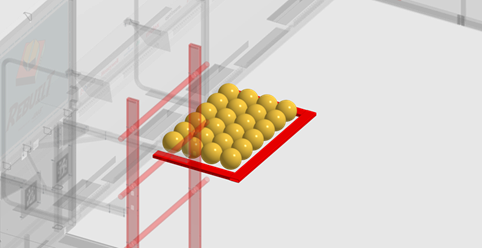
A

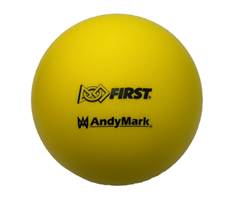
FUEL
is a 5.91in (15.0cm) diameter, high density foam ball.
FUEL
is a custom made SCORING ELEMENT available for purchase on the AndyMark website, am-5801.

FUEL
has a weight of between 0.448-0.500lb (~0.203-0.227kg).

FUEL
undergoes wear and tear during a competition. Generally, a
FUEL
that still appears to look approximately like a
FUEL
is considered a
FUEL
for the purposes of rule evaluation and scoring, whether damaged or not. Small chunks of a
FUEL
are not considered a
FUEL
.

Most new

FUEL
will have small impressions due to being pressed against other
FUEL
or the sides of the packaging during shipping. These impressions are purely cosmetic and do not affect the function of the
FUEL
. Most impressions will gradually disappear as the
FUEL
is used.

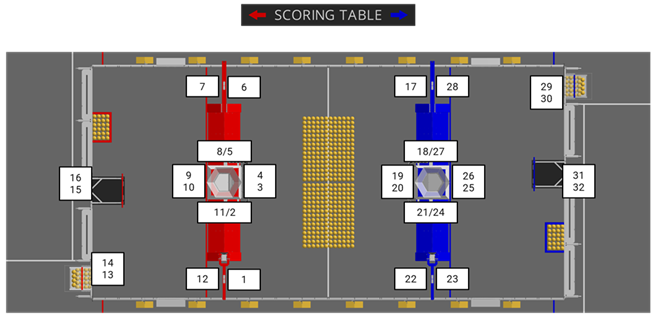
5.11 AprilTags

AprilTags are 8.125in (20.64cm) square targets located on the
HUB
,
TOWER
WALL,
OUTPOST
, and
TRENCHES
. There are 32 unique markers on the
FIELD
positioned as shown in Figure 5‑21.

Figure 5‑21 AprilTag Locations

image

All markers are from the 36h11 tag family, IDs 1-32. All AprilTags are mounted to and centered on a 10.5in (26.67cm) square polycarbonate panel. Each marker has an identifying text label. If AprilTags experience wear and marking during
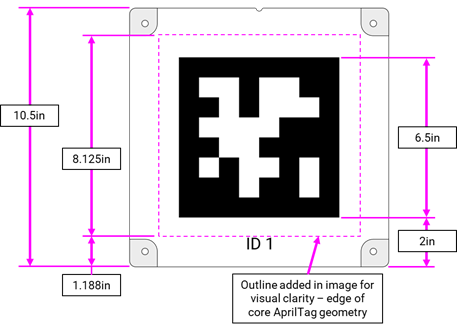
MATCHES
they are repaired with gaffers tape.

Figure 5‑22 AprilTag sizing

image

HUB
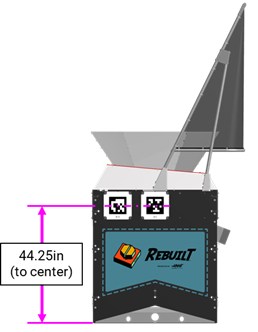
AprilTags (IDs 2, 3, 4, 5, 8, 9, 10, 11, 18, 19, 20, 21, 24, 25, 26, 27) are located on all four faces of the
HUB
. Each face has two AprilTags with centers located 44.25in (1.124m) off the floor as shown in Figure 5‑23. One AprilTag per face is centered and the other AprilTag is horizontally offset.

Figure 5‑23
HUB
AprilTags

image

Two AprilTags (IDs 15, 16, 31, 32) are located on each
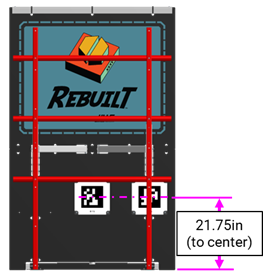
TOWER
WALL with centers 21.75in (55.25cm) off the floor as shown in Figure 5‑24. One AprilTag per
TOWER
is centered and the other AprilTag is horizontally offset.

Figure 5‑24
TOWER
WALL AprilTags

image

Two AprilTags (IDs 13, 14, 29, 30) are located on each
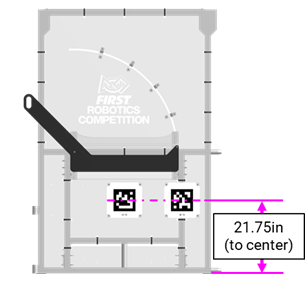
OUTPOST
with centers 21.75in (55.25cm) off the floor as shown in Figure 5‑25. One AprilTag per
OUTPOST
is centered with the
CHUTE
and
CORRAL
openings and the other AprilTag is horizontally offset.

Figure 5‑25
OUTPOST
AprilTags

image

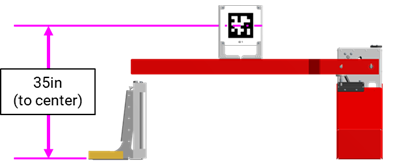
TRENCH
AprilTags (IDs 1, 6, 7, 12, 17, 22, 23, 28) are attached to mounting brackets located on the top surface of the horizontal arm of the
TRENCH
. Each
TRENCH
has two AprilTags, one facing the
ALLIANCE
ZONE and one facing the NEUTRAL ZONE.
TRENCH
AprilTags are approximately centered on the opening under the
TRENCH
arm and their centers are located 35in (88.9cm) off the floor as shown in Figure 5‑26.

Figure 5‑26
TRENCH
AprilTags

image

For further marker locating information please refer to the 2026

Dimension Drawings. Printable copies of the
field
AprilTags can be found on the Playing
FIELD
webpage
.

5.12 The
FIELD
Management System

The

FIELD
Management System (
FMS
) is all the electronics responsible for sensing and controlling the FIRST Robotics Competition
FIELD
. The
FMS
encompasses all
FIELD
electronics, including computers,
REFEREE
touchscreens, the wireless access point, sensors, stack lights, A-Stops and E-Stops, etc.

When a DRIVE TEAM connects the Ethernet cable from their assigned

DRIVER
STATION to their OPERATOR CONSOLE, the
Driver
Station Software on the OPERATOR CONSOLE computer communicates with
FMS
. Once connected, the open ports available are described in Table 8‑5.

Note that

ROBOT
code cannot be deployed while connected to the
FMS
. Additional information about the
FMS
may be found in the
FMS
Whitepaper
.

The

FMS
alerts participants to milestones in the
MATCH
using audio cues detailed in Table 5‑4. Please note that audio cues are intended as a courtesy to participants and not intended as official
MATCH
markers. If there is a discrepancy between an audio cue and the
FIELD
timers, the
FIELD
timers are the authority.

Table 5‑4: Audio Cues
EventTimer Value(s)Audio Cue
MATCH
start
0:20 (for
AUTO
)
“Cavalry Charge”
AUTO
ends
0:00 (for
AUTO
)
“Buzzer”
TELEOP
& TRANSITION begins
2:20“3 Bells”
ALLIANCE
SHIFT
starts
2:10 1:45 1:20 0:55None
END GAME begins0:30“TBD”
MATCH
end
0:00“Buzzer”
MATCH
stopped
n/a“Foghorn”

5.13
FIELD
STAFF

FIELD
STAFF are responsible for making sure the
MATCHES
are cycled through efficiently, fairly, safely, and with a spirit of cooperation, Gracious Professionalism, and generosity of spirit.
FIELD
STAFF roles are filled by volunteers from the community who prepare for the event with thorough training and certification. There are 3 FIELD-side key volunteer roles with whom teams should be familiar and are encouraged to use as resources to make their event experience valuable (in whatever way the team defines “valuable”).

  • Head
    REFEREE
    – trains, directs, and supervises
    REFEREES
    . They oversee all scoring processes and procedures in collaboration with the FIRST Technical Advisor (
    FTA
    ). They interact with
    STUDENTS
    , volunteers, and contracted/FIRST staff. The Head
    REFEREE
    is positioned between the
    FIELD
    and the scoring table and wears a yellow shirt. The Head
    REFEREE
    has final authority for decisions regarding
    MATCH
    scores, penalties, and YELLOW and RED CARD assignments. For additional details, please refer to the Head
    REFEREE
    role description
    .
  • FIRST Technical Advisor (
    FTA
    ) - ensures events run smoothly, safely, and in accordance with FIRST requirements. The
    FTA
    collaborates with FIRST staff, event staff, and other event volunteers in many different areas at events. The
    FTA
    is the liaison between FIRST HQ and the event for all things related to the
    FIELD
    ,
    ROBOTS
    , and game, acts as a team advocate for all teams competing at the event and is a major point of escalation and conflict resolution for the event. For additional details, please refer to the
    FTA
    role description
    .
  • FIELD
    Supervisor - directs activity on the
    FIELD
    to ensure efficient execution of the
    MATCHES
    , pacing of the event, and smooth flow of
    MATCH
    play.
    FIELD
    Supervisors are responsible for ensuring the
    FIELD
    is intact and lead
    FIELD
    Reset teams, who are responsible for resetting the
    FIELD
    after each
    MATCH
    in preparation for the subsequent
    MATCH
    . For additional details, please refer to the
    FIELD
    Supervisor role description
    .

image